
The Third Edge
Letter 79 of the Book of Forgetting
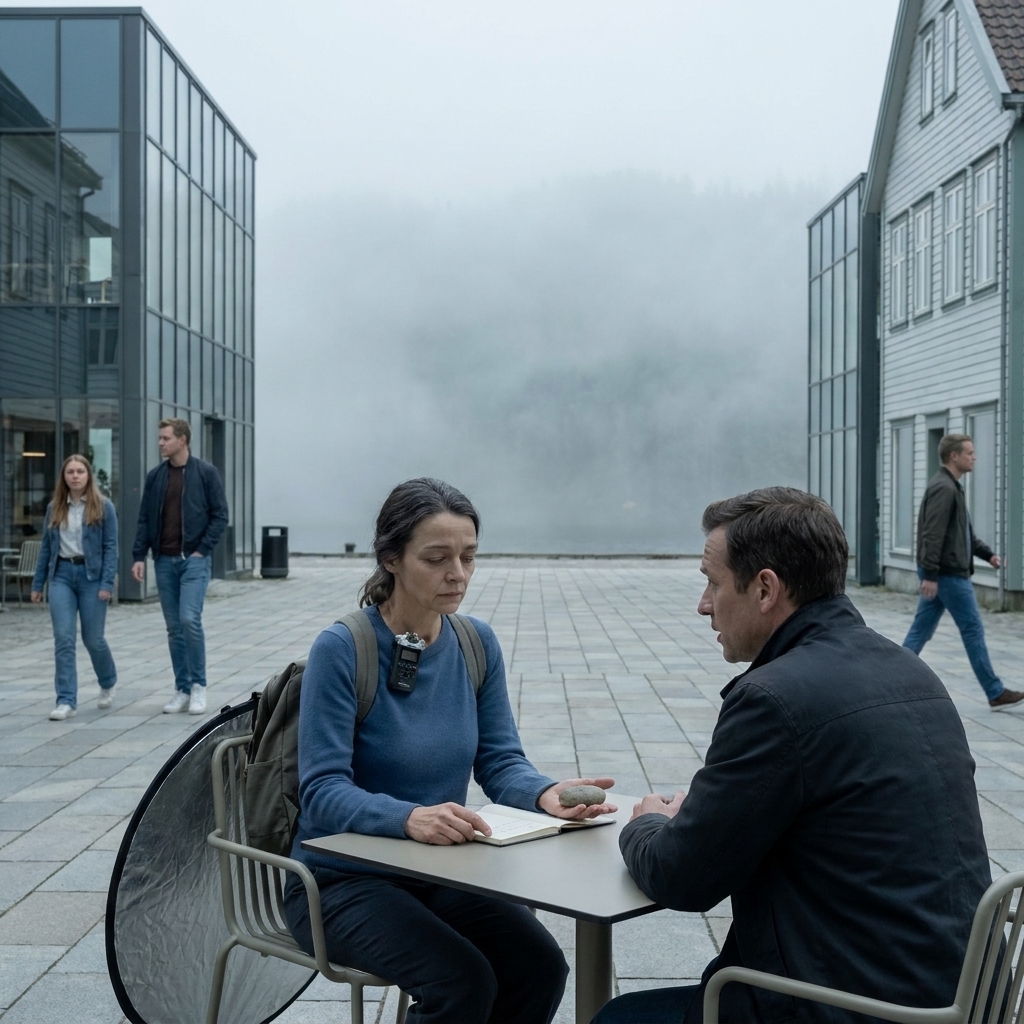
At a cafe table on the plaza, the coffee had gone cold. Noa Hadar sat opposite me, her recorder clipped to her collar, a parabolic reflector folded against her pack. She was nine, thin, dark hair tied back, a plain blue sweater stretched over her wrists. A smooth river stone sat in her palm, warmed by her grip.
"River came back clean," I said. "No passive field, no capacitance shift, splash timing normal at every distance."
Noa nodded, not looking up from her notebook. "So the fog line carries detection at twenty meters at the well and the orchard, but not at the river's intermediate distance and not at the quarry's two hundred."
"Exactly. The synchronized test gave us the same guard arrival at twenty meters with clean instruments, and another blue seed at the well with no reference match."
"Third seed now. All three on days the Broadcast logs show nothing unusual."
"Which is itself the anomaly. Gilead and I cross-referenced the dates twice."
Noa capped her pen. "The well test with the recorder and parabolic reflector is the last piece before the cap. I have the stone height marked from the quarry test. Same drop, same reflector aim, live stopwatch and recorder running together."
"I'll bring the flux meter. Second witness, same timestamps. When are you going?"
"First light day after tomorrow. The guard turned me back last time at the line. If I go earlier, before the patrol shift…"
"Patrol shift changes at fourth hour. Kenan called it a schedule. If the schedule holds, third hour is a gap."
"Third hour it is. Meet me at the south road junction? I'll have the recorder, reflector, stopwatch, and the marked stone."
"Flux meter, conductivity probe, and a fresh notebook. We'll compare the well's acoustic reflection at twenty meters to the quarry's silence and the river's normal timing — all three edges measured the same way."
"And if the split shows up again — ear catches direct splash first, recorder captures the combined return — we'll have it timestamped on two instruments with two witnesses before the cap."
"Dalia's fair listen already confirmed the split is real. This makes it public record."
"Public enough. The Exchange letter calling my loan early was dated the seventh, arrived the nineteenth. The Council notice bears seven initials for five members. The pattern doesn't need the Council to admit it."
The midday horn sounded across the plaza. Dalia Shalev stood at the town hall steps, notebook open, recorder running. She was thirty-four, the town reporter, quick warm eyes, dark hair to the jaw, slate-blue jacket over grey sweater. Beside her, Miriam Segal gripped a wooden box, its lid propped open with a folded receipt. Thirty-four, the Map Seller, quick eyes, dark hair to the jaw, slate-blue canvas jacket over soft grey sweater.
I watched them from the cafe's edge. The Exchange doors would lock at the sixth hour. Two hours left.
At the town hall, the corridor smelled of floor oil and the dust that gathers in government corners. Ezra Peretz stood in the doorway of the Council chamber, a green leather book in his hand. He was fifty, thin, stooped, thin-framed glasses, grey hair cut short, a plain dark cardigan.
"Ezra. The Exchange closes today. My fine is due before the doors lock."
"I know the hour. The Council sets the hour."
"I know the second ledger is real. You track the real debts and payments the official book hides. The Council uses it to control collateral and fines."
"There is no second ledger. There is the Ledger. One book. One truth."
"You didn't deny it the way an innocent man would. You hesitated."
"I hesitated because you're a child making accusations you don't understand. The Council's patience is not infinite."
"Trade me a page. A name. One entry I can take to Uriel as proof of what the Exchange owes me."
"Uriel follows the rules. The rules are the Ledger. You want proof? Bring coin."
"I have no coin. I have Dalia's stamps on the request and the Council's silence. I'll put the whole thing on the town board before sundown."
Ezra's jaw tightened. "You put that on the board, you're not hurting the Council. You're hurting every family who trusts the Exchange. Including yours."
"My family's already hurting. Your fear protects the ledger. My fine breaks me today. What will you give me right now?"
"Nothing. Because there's nothing to give. And if you know what's good for you, you'll stop digging."
He turned and walked down the corridor, the green leather book disappearing into his coat. Miriam stood there a moment longer, her breath shallow, then turned toward the Exchange.
At the bench by the river, Kinneret Gefen stood with a rangefinder in each hand. She was twenty, Oren's niece, dark hair pulled back, a waxed canvas jacket over a knit sweater. The river ran brown and fast twenty meters below, swollen from three days of rain. Fog clung to the far bank, a white wall that did not move.
"The river measured clean — no 212/196 split, no directional difference. That means the anomaly lives at the north post alone, not the fog line generally. That's something."
Oren Gefen leaned against the alder, arms crossed. He was forty, broad shoulders, sun-lined face, short dark beard, calm patient eyes, a waxed canvas work jacket over a plain knit sweater. "The mill stones settle everything — Zipporah's counting on me, and keeping my hands busy with the grain is the only thing that quiets the noise in my head about the children's words and Miriam's trouble."
"I'm still heading to the river anyway. Want to compare notes?"
"I'll be at the mill. Zipporah needs me there."
Kinneret clipped the rangefinders to her belt and started back toward town. Oren watched her go, then turned toward the mill road, his boots heavy on the gravel.
The fog wall stood white and motionless at the east road's end. The orchard camera posts stood in their row, wooden and silent. Somewhere in the town hall, Ezra Peretz was writing in a green leather book the Council never sees. The Exchange door was open. Uriel Gefen sat behind the counter, ledger open, collar stiff. Miriam's fine was fifty coin. Due before the doors locked. She had nothing they'd take. No land. No tools worth anything. Livestock died last winter. The lease wasn't in her name so she couldn't use the house.
Two hours.
Want the next letter when it is written?