
The Fifth Box
Letter 7 of the Book of Forgetting
The afternoon came in warm and close, and I was at my bench fitting a new lens into a survey drone when Noa came in without knocking, her blue sweater bright against the grey that pressed at the window.
“Fernando,” she said. “Liesl had five babies.”
I set down the lens. “Five?”
“All born before dawn. All at once. The midwife said they came out like a litter.” She held her river stone in both hands. “And they’re all dreaming the sentence.”
“All five?”
“All five.” She counted on her fingers. “Adah, Obed, Hannah, Uzziah, Kenan. The midwife wrote them down for my mother so I could tell you.”
I stood up and reached for my jacket. “Let’s go see Liesl.”
Liesl’s house was small and neat, the windows open to the warm air. She sat in a chair by the bed, a baby in her arms, two more in a bassinet beside her, two in a basket on the floor. Her dark hair was loose, her arms bare, the small sparks-burns of her work still visible on her forearms. She looked at me with the same direct stare she used on a warped rail or a cracked housing.
“Fernando,” she said. “You came.”
“I came to see the five.”
She looked down at the baby in her arms. “This one is Adah. She woke up an hour ago and said it. ‘The fog is just fog.’ Clear as a bell. Then she went back to sleep.”
“And the others?”
“Obed woke next. Said a different one.” She looked at me. “‘The fog does not measure the same twice.’ Then he went back to sleep. Hannah woke after that. Same as Adah. ‘The fog is just fog.’ Uzziah same. Kenan same.”
I stood by the bed, the babies breathing in their own rhythms, none of them matched. “Obed’s is different.”
“Obed’s is different.” Liesl shifted the baby in her arms, her thumb stroking its cheek. “Five babies, four saying the same thing, one saying something new. I don’t know what to make of that.”
“I don’t either,” I said.
She looked at me a long moment. “You keep the record, Fernando. What does the record say about babies who speak different sentences?”
“The record says what happened,” I said. “It doesn’t say what it means.”
She nodded slowly, her hand tightening around the baby’s small body. “Malachi came by this morning,” she said. “Before I even had them fed. He wanted to see the babies. He said he was measuring them.”
“Measuring them?”
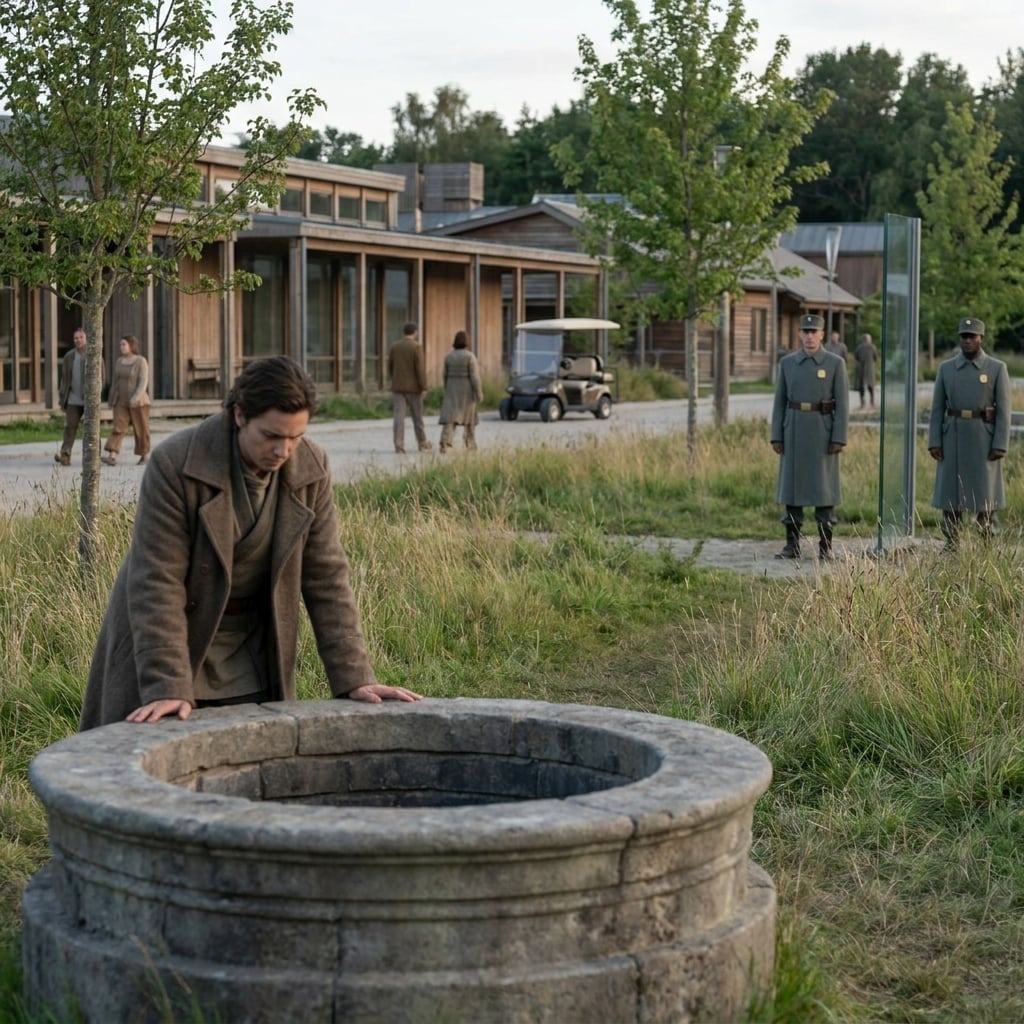
“I don’t know what that means either.” She looked at the baby in her arms. “He stood over the bassinet for a long time, counting their breaths. Then he left. He said he had to go to the old well.”
The old well was at the edge of the orchard, dry for as long as anyone remembered. I had passed it a hundred times. I had never dropped a stone down it.
“Malachi’s been measuring things,” I said. “He’s been at the fog line with a camera, timing stones.”
“I know.” Liesl’s voice was flat. “He told me he was building something. A better instrument. He wanted my help with the metal work.”
“Did you help him?”
“I gave him a length of brass. He said it would do.” She looked at me. “He’s ninety-four, Fernando. He should be asleep like the others. Instead he’s measuring the fog and timing stones and counting my babies’ breaths.”
I didn’t know what to say to that. I stood by the bed a moment longer, the babies breathing, the warm air holding the smell of milk and sleep.
When I left, Liesl was still sitting in the chair, Adah in her arms, her eyes closed, her hand moving in a small steady rhythm against the baby’s back. I walked up the street toward the orchard, and I thought about the old well, and about Malachi, and about the sentence Obed had spoken, which was not the sentence the others had spoken, and which I did not understand.
Want the next letter when it is written?