
A person of Neshiyah
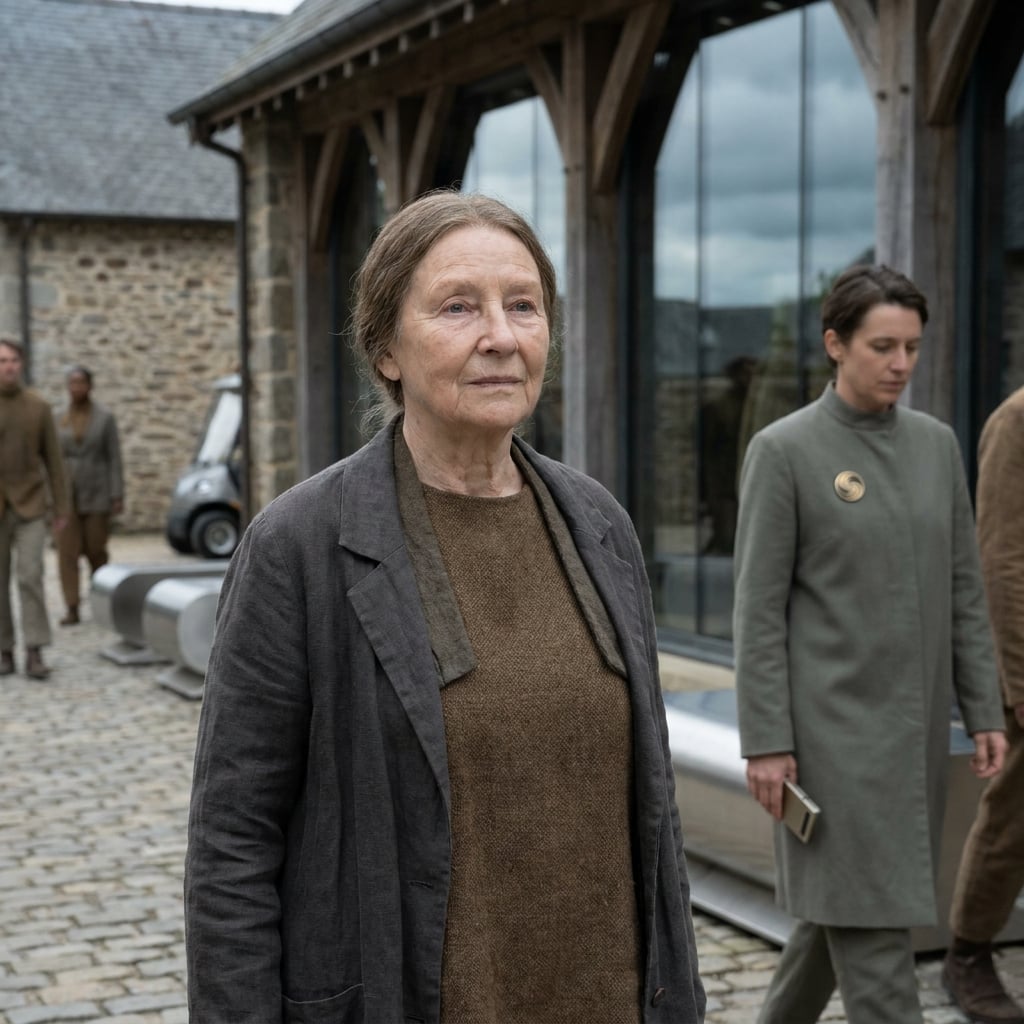
Zipporah Gefen, retired, once ran the mill
The Miller's Widow
Zipporah Gefen
Retired, once ran the mill, about 7 years old. This is the second life this soul has lived in Neshiyah.
Zipporah Gefen keeps her hands busy the way the mill once did, measuring out feed or mending nets by the river, her fingers moving with a foreman’s precision long after the wheels stopped. She is a small, sturdy woman with flour-pale hair and eyes that narrow only when something is new in front of her—a strange tool, a cracked bank, a child’s question. Once a day she walks the waterline and taps the same stone with her heel, a habit she calls checking the river’s temper. She wants the mill’s ledger closed properly, though no one else remembers it’s open. The town treats her gently, as a widow should be treated—bringing bread, asking nothing—and lets her sit alone, trusting she will wave if the fog shifts. She carries her dream sentence like a pocketed stone, worn smooth, and, whenever she checks the river, she murmurs it once, low, just to hear if the words still hold the same weight.
Asked: Zipporah, good evening. I heard you spent the afternoon down by the river again—what keeps drawing you back there?
Zipporah: The water doesn't argue with you. It just goes, and it doesn't care if the fog is thick or thin. I sat there and watched the current for a good hour, and I got to thinking about how nothing here ever seems to stay the same twice, even the river.
Asked: That's a strange thought to carry around. Where do you think it comes from?
Zipporah: I wish I knew. I've had this sentence in my head since I was a child—"the fog does not measure the same twice"—and it feels like a memory, but not mine. I've never told anyone until now, because it sounds like I'm making it up, but it won't leave me alone.
Read the rest
Asked: And now your daughter, little Zipporah, says the same words in her sleep. That must have shaken you.
Zipporah: It did, more than I can say. She's only a few weeks old, and she doesn't know words yet, but she wakes up and says it clear as day, like she's been holding it for a long time. I asked Uriel if he'd ever said it to her, and he just looked at me like I had two heads.
Asked: What do you make of the fog itself, then—after a life of farming under it?
Zipporah: I used to think it was just weather, something to work around. But now I wonder if it's more like a curtain that shifts when you're not looking. I've walked the same field line a thousand times, and sometimes the edge feels closer than it did the day before, even though I never moved the fence.
Asked: You mentioned the mill earlier—did you ever see anything odd from the mill's high window?
Zipporah: Once, when I was still running it, I looked out at the fog at dusk, and for a second I thought I saw a shape—like a house, but not our kind of house. It was there and then it wasn't, and I told myself it was a trick of the light. But I never went back up there after that, not alone.
Asked: Do you think your daughter's words and that shape are connected somehow?
Zipporah: I can't prove it, but I feel it in my bones. It's like the fog is trying to tell us something, but it's speaking in a language we only catch in fragments. I just don't know if it's a warning or a welcome, and that's the part I can't answer.
Asked: What would you do if you could step through the fog tomorrow, just to see?
Zipporah: I'd probably take a loaf of bread and a good coat, and I'd walk until I couldn't walk anymore. But I'd also be scared, because what if I never came back, and what if my daughter says those words again and I'm not there to hear her? That's the thing—I want to know, but I'm afraid of what knowing costs.
Asked: What do you hope is out there, if anything at all?
Zipporah: I hope it's just more fields, more river, more fog on the other side. I hope it's not a wall, and I hope it's not a door. But I've been hoping that for fifty years, and the fog still doesn't measure the same twice, so maybe hope is all we've got.
Asked: If you could ask the fog one question, what would it be?
Zipporah: I'd ask it why it gave my granddaughter those words before she could even open her eyes. But I don't think it would answer, because it's never answered anyone before. It just sits there, gray and quiet, and lets us wonder.
Asked: Zipporah, thank you for sharing that with us tonight. It's a lot to sit with.
Zipporah: Thank you for listening. I'll go back to the river tomorrow, and maybe I'll figure out something new, or maybe I won't. Either way, the fields still need working, and the fog will still be there, doing whatever it does.
Temperament
Curious when something is in front of them; trusting, within reason; hard to anger; happiest alone; given to sitting by the river.
What people say
Zipporah Gefen believes what everyone believes: the fog is the edge of the world, and the fields need working whether it is true or not.
The dream
Since the morning they were born they have carried a sentence in a voice like their own: “the fog does not measure the same twice.”
What the record shows
- day 49 Zipporah Gefen the retired, once ran the mill fell ill with the valley fever and lost three days to it.
- day 48 Zipporah Gefen the retired, once ran the mill found a seventh stone block in the quarry, where the survey lists six.
- day 45 Uriel Gefen says that their new daughter, Zipporah Gefen, wakes from sleep repeating words no one taught: "the fog does not measure the same twice."
- day 45 A daughter, Zipporah Gefen, was born to Uriel Gefen.