
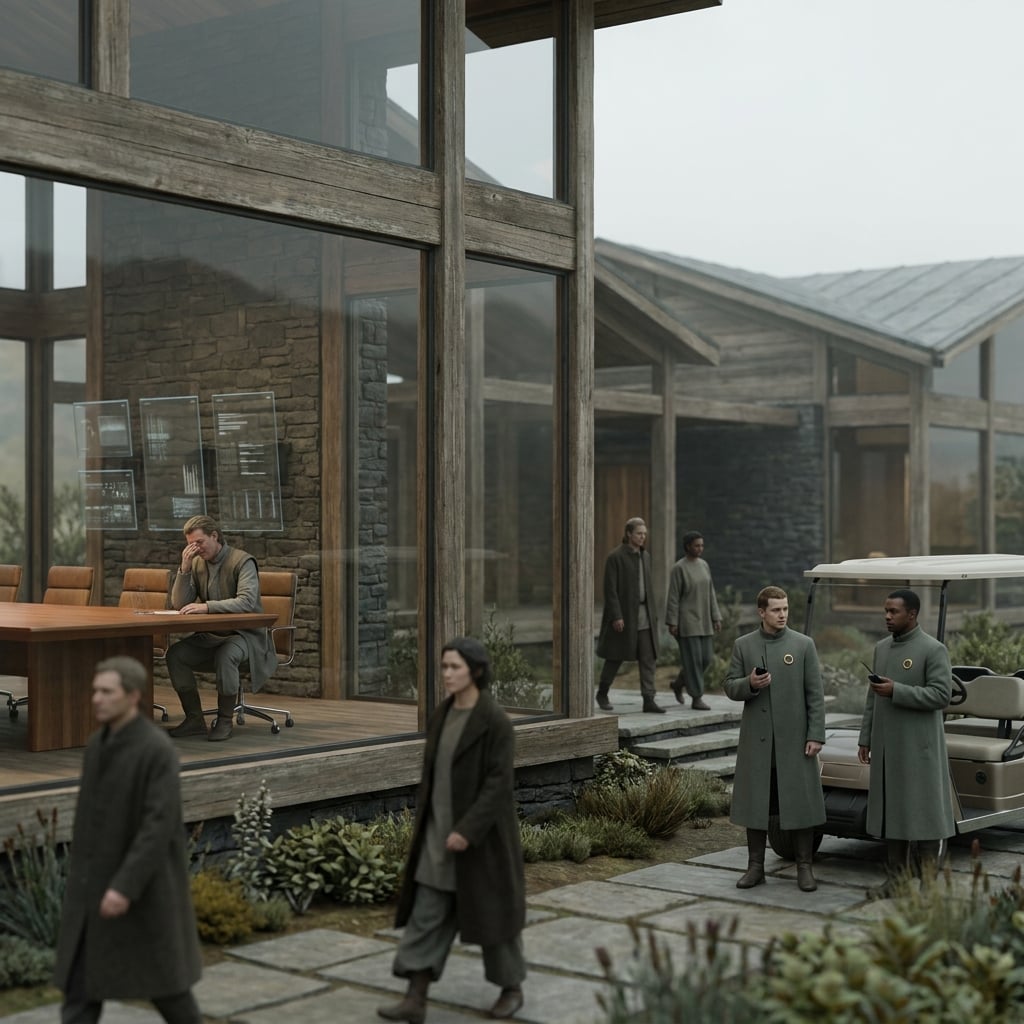
The Two Names
Letter 4 of the Book of Forgetting
That morning came in cold and still, the fog pressing at the road ends like it always did, and I was at my bench fitting a new thread into a survey drone’s mount when Noa came in without knocking, her blue sweater clean but thin at the elbows.
“Fernando,” she said. “My mother says the babies are dreaming again.”
I set down the thread. “Which babies?”
“Four this time. Tamar the younger and Hillel the younger and Orpah the younger and Seth. The midwife came by our house to tell us. They all dreamed the same sentence.”
I knew the sentence. I had known it for weeks, the way I knew the weight of my own rangefinder. *The fog is just fog.*
“And Miriam the younger,” Noa said. “She was born too. That’s five. And Tamar the younger the surveyor died this morning, and Ruth the younger the tailor, and Shiloh the gardener, and Ariel the surveyor, and Yael the quarry worker, and Meir the younger the electrician—no, wait.” She frowned, counting on her fingers. “Meir the electrician didn’t die. He measured the fog. Two-twelve going out, one-ninety-six coming back.”
“He did,” I said. “Same as the rest of us.”
“And Silas the dealer died. The map seller. He was eighty-two.”
I had known Silas. He had sold me my first map of the town when I was young, before I knew how to make instruments, before I knew the fog line the way I knew my own hands. He had been kind. He had believed in maps, even maps of a town surrounded on every side by a wall of grey.
“He went asleep,” Noa said. “Like the others.”
The old ones went asleep, one by one, quietly, in their beds, and the babies came awake dreaming a sentence in a voice like their own. I had stopped saying anything about it to the Council, and the Council had stopped asking. Garrin came by my shop that afternoon, his tablet under his arm, his thin glasses catching the grey light.
“You heard about the births,” he said.
“I heard.”
“Five babies, all dreaming the same sentence. The Council wants a note in the record.”
“I keep the record,” I said. “I’ll note it.”
He stood a moment, his mouth closed, his eyes tired behind the glass. “And Silas. You’ll note him too.”
“I will.”
He nodded and turned to go, then stopped at the door. “The town has lost its map seller. I don’t know who draws the maps now.”
I didn’t know either. I thought about Silas’s shop, the shelves of folded paper, the smell of ink and dust. He had drawn the town from the survey posts out to the fog line, and the fog line on his maps was always a clean straight edge, like a knife cut. He had never drawn anything beyond it. He had never said why.
Liesl came by at sunset, her work apron still carrying the smell of metal and oil. She stood at my door and looked at me.
“You heard about the babies?” she said.
“I heard.”
“Five of them. Same sentence. And six dead from yesterday and today.” She counted on her fingers. “Silas the dealer, Ruth the younger, Tamar the younger, Shiloh, Ariel, Yael. Six.”
“I know.”
She looked at me a long moment, her dark eyes steady. “You’re counting something, Fernando. I can see it in your face.”
“I’m counting names,” I said.
She waited.
“Five born,” I said. “Six died. One of them the map seller. And the fog measures different depending on which way you walk.”
Liesl didn’t answer. She stood in my door a moment longer, then nodded once and went out into the grey evening, and I sat at my bench with the rangefinder in my hands, the thread half-fitted, the light going thin and low over the town.
Want the next letter when it is written?