
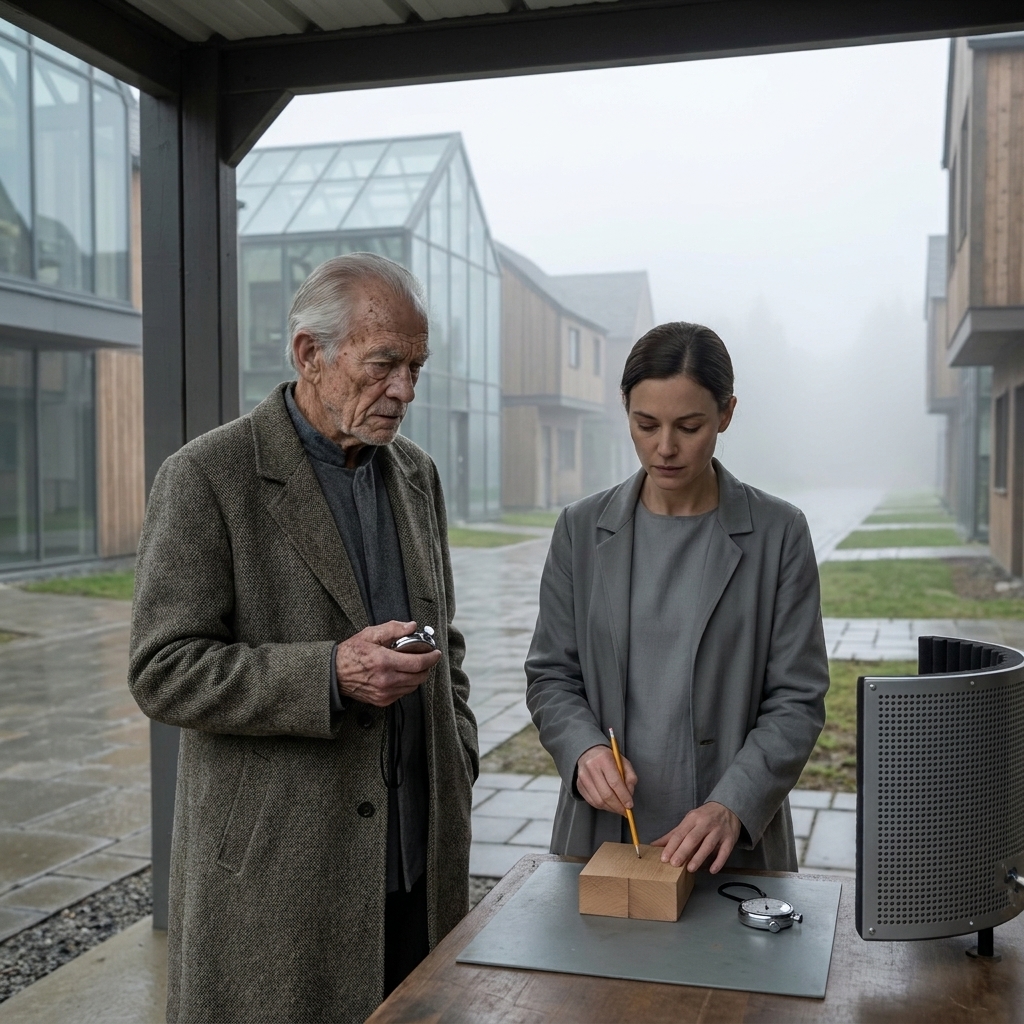
The Tap and the Block
Letter 37 of the Book of Forgetting
The old mill smelled of damp wood and cold iron. Liesl Kfir had cleared a space on the workbench near the door, setting the wooden block at the center and her stopwatch beside it. Garrin Zohar came up the path at 9:14, carrying the sound shield under one arm and a pencil behind his ear.
“Thanks for coming,” Liesl said. “Let's do this clean, away from the well.”
“Fine,” Garrin said. He set the shield down and pulled a second stopwatch from his coat pocket. “If it's me, I'll hear it. If it's this place, you'll hear it too.”
“I'll tap the block ten times. You time each tap. I'll write down your counts as I go.”
“You're counting with your own watch, right? Not relying on my word.”
Garrin held up his stopwatch. “I'm using this and a pencil. We'll compare after the tenth tap.”
Liesl picked up a short steel rod from the bench. She held it over the block, waiting. The mill was quiet except for the drip of water somewhere in the dark.
“First tap,” she said. The rod struck. “One.”
Garrin pressed his watch. “Second.” Strike. “Two.”
They went on that way, Liesl counting aloud, Garrin timing each strike and writing in a small notebook. At the third tap she paused.
“Wait. That felt off. The tap and the sound seemed to come together that time.”
“Keep going,” Garrin said. “Don't stop to analyze. Just count.”
“Four… five… six… seven… eight… nine… ten. There. All in a row. No lag.”
Garrin looked at his watch, then at his notebook. “My watch shows the same. Every tap, sound, and second lined up. That's a clean test.”
Liesl set the rod down. She stood there a moment, her hands flat on the bench.
“So it's the well. Or it's the fog near the well. But not my ears.”
“Not your ears, and not my clock,” Garrin said. “But that still doesn't tell us why the well lags.”
“I'll take it to the Council. I've been saying it's the place, not me. Now I have proof.”
Garrin closed his notebook. “You have one clean test. I'd want another at noon before I make a claim. But I'm not stopping you.”
Liesl picked up her stopwatch and turned it over in her hand. “You know what it felt like, at the third tap? Like the sound arrived a half-beat early. Not late. Early. Like something was hurrying to meet it.”
Garrin said nothing.
Noa Hadar came through the mill door at 9:31, her phone in her hand. She saw the block and the stopwatches and stopped.
“You ran it without me.”
“You were late,” Liesl said. “We ran it clean. Ten taps, no lag.”
Noa looked at Garrin. “Did you mark the intervals yourself?”
“Yes,” Garrin said. “Every one.”
Noa set her phone on the bench. “Then I want to run it again, with the sound shield over the block. If the lag appears when the sound is muffled, it changes what we think the well is doing.”
Liesl looked at the shield—a curved sheet of metal Garrin had brought, the kind used to direct sound in the workshop. “Fine. Set it up.”
Garrin placed the shield over the block, leaving the front open toward Liesl. He tapped the block once. The sound came through, dulled but clear.
“Again,” Liesl said. “Ten taps.”
They ran it a second time. Liesl counted, Garrin timed. At the sixth tap, Liesl stopped.
“There. That one lagged. A full beat after the strike.”
Garrin checked his watch. “My watch shows the strike and the sound together. No gap.”
Noa stepped closer. “Play it back. You recorded it?”
Liesl shook her head. “No recorder. I counted aloud and he timed.”
“Then we have nothing to compare,” Noa said. “One person's ear says lag, one watch says clean. That's exactly the problem we started with.”
Liesl stared at the block under the shield. “But I felt it. The sixth tap. The sound came late.”
Garrin put his pencil behind his ear. “I'll run it again with you wearing the headphones, hearing only clicks. If the lag follows you, it's your hearing. If it doesn't, we have something.”
Liesl nodded slowly. “Set it up. I want to know.”
Noa picked up her phone and began marking the time. Outside, the fog held its grey light against the mill windows.
Want the next letter when it is written?