
The Direction of the Fog
Letter 43 of the Book of Forgetting
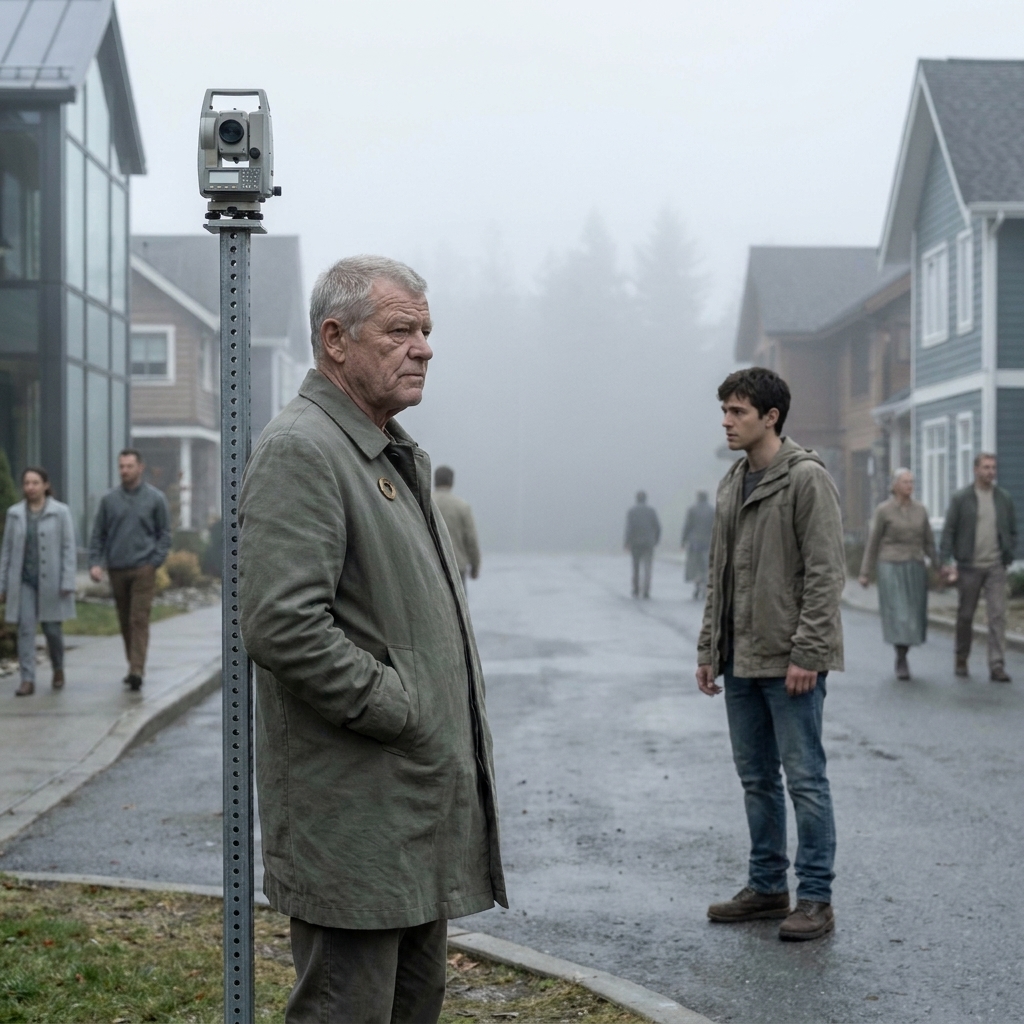
The north survey post stood at the edge of the fog at 9:15. Ivo Segal was already there when Ophir came up the road, his son's boots scuffing the damp gravel. Ivo had his hands in his jacket pockets, the rangefinder on the post beside him.
"Ophir," he said. "I've heard you say it in your sleep—'the fog is just fog.' Where did you get that?"
Ophir stopped. He was twenty-two, a surveyor's assistant, his father's build but softer around the jaw. "Dad, it's just a dream. I've had it since I was a kid. You know that."
"I know what you've told me. But you've been saying it more lately. And I'm not the only one who's noticed strange things at the line."
"Like what? The rangefinder thing? That's just a tool. Tools misread."
Ivo picked up the rangefinder. "Rivka's got the same tool reading 212 going out and 196 coming back. Same distance, same post, same day. That's not a misread."
"Maybe it's the battery. Or the heat. There's always a normal reason."
"I want to believe that. But you're my son, and I can't shake the feeling those words mean something."
Ophir took a breath. "They mean what they say, Dad. The fog is just fog. I've walked it my whole life."
"Then walk it with me now. Let's measure the gap ourselves, right here, and see what your eyes tell you."
Ophir looked at the fog line. It was quiet, grey, motionless. "Alright. But I'm telling you, it's going to be 16 meters like it always is."
"We'll see. Hand me the rangefinder."
Ophir handed it over. Ivo raised it, pointed north toward the fog, and read the display. "212 meters."
He turned, pointed south toward town. "196."
"Same gap between the posts," Ophir said. "Same tool. Same hands."
"Same hands," Ivo repeated. He lowered the rangefinder. "Your mother used to say the fog was a curtain that wouldn't lift. She said it in her sleep too, near the end."
Ophir was quiet. Then: "I don't remember her saying that."
"You were six." Ivo clipped the rangefinder to his belt. "The words you say in your sleep—they came from somewhere, Ophir. They didn't grow in the ground."
Ophir stared at the fog. "Maybe they did. Maybe everything did."
Ivo didn't answer. They stood there a long moment, father and son, the grey wall before them.
At the old mill, the waterwheel turned slow at 11:40. Noa Hadar spread the marked transcript on the bench. Liesl Kfir sat beside her, the voice memo queued on Noa's phone.
"Let's play it slow, no stopwatch, just our ears and the paper," Noa said.
"Fine. But I'm marking where I hear the cue, and where the splash lands. If your marks don't match mine, we'll know."
Noa played the recording. Liesl's voice came through: "Stone." Then the splash. Noa put her pencil on the paper.
"I marked the release at the same spot we did before. The splash comes later on the tape than it should, by about a second."
"And the second sound—right after my cue, not after the splash. You hear that too, don't you?"
"I do. Dalia heard it as well when she listened. So it's not just you, and it's not just me."
"Then it's real. Not my old ears. Real. And we take this to the Council tonight."
"We take the transcript and the memo. But we should be careful—the guard at the well turned us back. If they see this as trouble, they might stop us."
"Let them try." Liesl's voice was hard. "I've got knuckles that remember Caleb's face. We're not hiding anything."
"I'm not hiding. I just want the Council to hear it plainly, not as a fight. We mark it, we play it, we let them decide."
Liesl was quiet a moment. "Decide what? That the well echoes wrong? That the wall counts different for Zipporah and me? It's all the same thing—the town isn't right."
"Maybe. But I still want to test the hall recording again, to see if the second sound shows up there too. If it doesn't, it's tied to the well."
"Fine. We play it for the Council first. Then you can chase your hall ghosts."
"Agreed. Let's mark the paper one more time, together, so there's no question."
They leaned over the transcript, their pencils moving in the same places.
At the old well that evening, Garrin Zohar set his recorder on the stone coping. The light was going grey. Liesl stood at the edge, watching the water.
"Set the recorder here, on the coping," Garrin said. "Speak your cue word into it, plain and clear."
Liesl leaned in. "'Stone.' There. Now play it back, and we'll see if the water answers a voice that isn't here."
Garrin pressed play. The recording spoke: "Stone." A splash came off the water below, a full second later.
"There it is," Liesl said. "Splash, a full second after the recording. Not after the cue, not after anything I said live."
"I heard it too." Garrin's voice was flat. "That's the first time I've heard it without you speaking. So it's in the recording itself."
"Or the well is answering the sound, not the person. Either way, it's not my hearing."
Garrin reached for the recorder. "Let me play it again, see if it repeats the same way."
"Wait—" Liesl pointed. "There's a guard coming down the path. He's not on the usual patrol time."
Garrin looked. A figure in grey moved through the dusk. "He's waving us off. We'll have to pack up. I'll keep the recording, mark it, and we can finish this at the hall."
Liesl picked up the recorder, handed it to him. "If the guard stops us now, we'll never get a clean run. But we have the one. That's enough for now."
The guard came closer. They gathered their things in silence. The well held its dark water, and nobody spoke.
Want the next letter when it is written?