
The Well and the River
Letter 75 of the Book of Forgetting
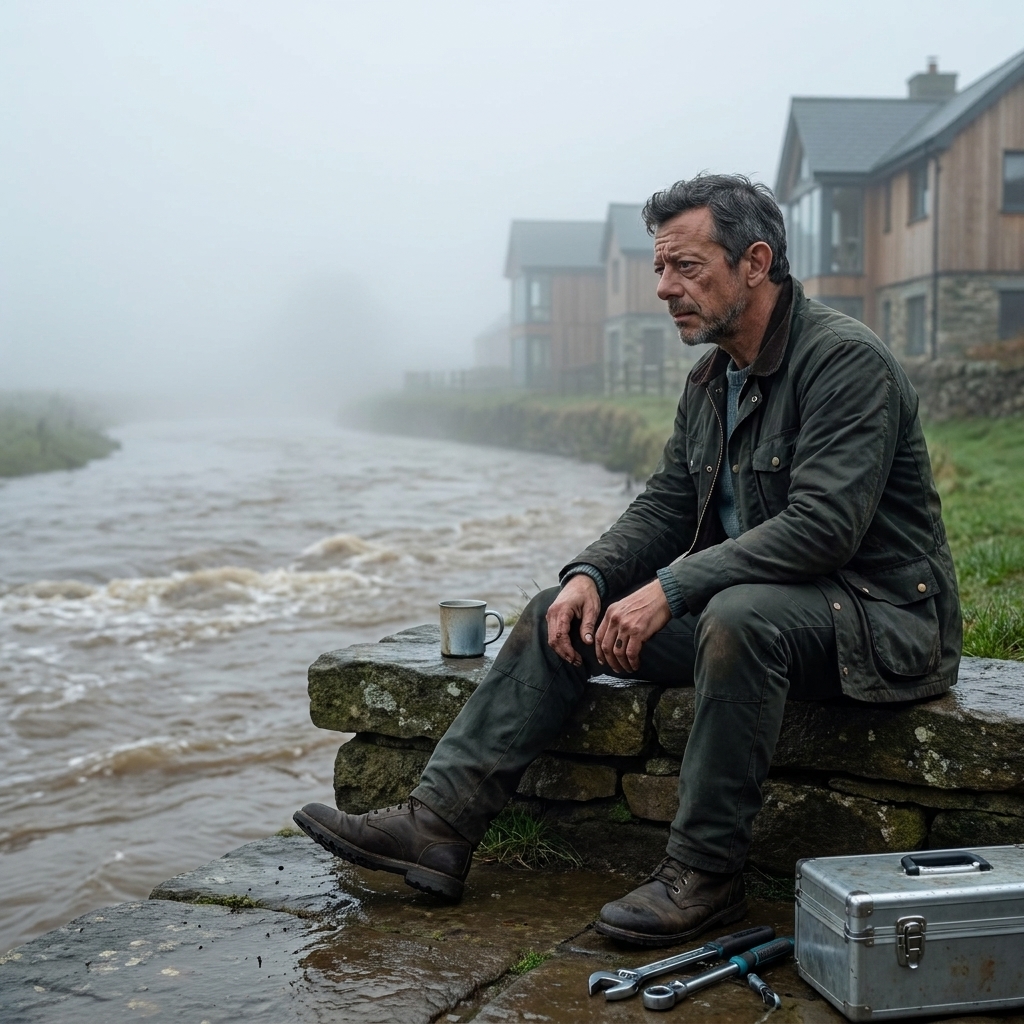
At the bench by the river, the coffee had gone cold. Gilead Meron set his mug down on the stone, the ceramic clicking against the wet surface. He was fifty, a mechanic with oil-stained fingernails and a limp he favored on the left side. The river ran brown and fast twenty meters below, swollen from three days of rain. Fog clung to the far bank, a white wall that did not move.
"You said you'd cross-reference the blue-seed dates with the Broadcast voice logs. Did you?"
"I did. Requested the raw overnight archives — not the voice-report logs, the continuous recordings."
"And?"
"Nothing unusual. Everything measured the way it should."
"That's the anomaly."
"Exactly. The gap between my seed dates and the official voice reports is a fact I can hold."
Gilead rubbed his knee. "The river's leaf drops still won't hold steady — 4.2 to 6.8 seconds, no pattern. Ten drops, ten times that drift apart like smoke."
"The well's split readings disagree in a repeatable way. Live ear 4.1, scrape 4.3, recorder 4.7. Quarry agrees at 1.7 both ways."
"Fog at the well is twenty meters. Quarry two hundred. River's between. If the fog reflects sound at the well but not the quarry, it may also distort the river's surface timing at close range."
"The fog changes what touches it: sound, time, and now the river's own clock."
"Seven initials on the Council notice. Seven stone blocks at the quarry. Blue seeds with no reference match. Rivka's silence. Nitzan's denial. The Broadcast archives showing nothing unusual — which is itself the anomaly."
"The guard's arrival at dead wood posts is triggered by something the town doesn't measure. I need to test whether the posts themselves carry a passive detection network."
"Before the well is capped next month. The Council's refusal, the seven initials, the fine after Nitzan's message, the well-capping notice — all align with preventing measurement before the fog's acoustic behavior is proven."
"I'm taking Miriam to the east orchard at first light. Conductivity probe and magnetic flux meter on each post. Then I'll stand at the fog line for three minutes while she times the guard's arrival from the twenty-meter mark."
Gilead nodded slowly. "The Council won't like that."
"They don't have to like it. They have to answer."
We sat there while the river ran. A leaf detached from an alder, spiraled down, hit the water. I counted in my head: four point something. Another leaf. Five point something. No two the same.
At the town hall, the corridor smelled of floor oil and the dust that gathers in government corners. Miriam Segal stood at the Exchange window, basket over her arm, face tight. Thirty-four, the Map Seller, quick eyes that noticed everything, dark hair cut to the jaw. Uriel Gefen sat behind the counter, ledger open, collar stiff. Fifty, thick through the shoulders, calm as someone who has counted the same coins for twenty years.
"Did you file it?"
"Filed and stamped. Both offices. Before close."
"What did they say about the lease?"
"Clerk took the copy. Said the Council will reply in writing. No timeline."
"Naomi's loan — early call, no reason?"
"Exchange accepted that page too. Uriel's window was shut."
"My fine. Thirty meters out. Due today."
"That page is in the packet. Council copy and Exchange copy."
"Ezra's second ledger. You put it in?"
"Fourth item. Whether it exists and why it differs from the official book."
"He denied it again. Same warning. Walk away."
"I wrote what you gave me. The Council has it now."
"Oren's voucher — did you get it in writing?"
"He'll bring it to the paper tomorrow. Farm on the line if he signs."
"Uriel won't take a neighbor's word. He told me himself."
"Rules are the Council's. Exchange follows. I asked about the letter's date too."
"And?"
"Kenan called it an Exchange matter. Uriel called it a Council matter. Same line."
Miriam's jaw tightened. She turned without another word, basket clicking against her hip, and walked past me toward the corridor's end. Dalia Shalev fell in beside her, notebook open, recorder clipped to her collar. Thirty-four, the town reporter for the radio and the paper, quick warm eyes that noticed everything.
At the west quarry, Efrat Segal found Leah Navon on a boulder twenty meters back from the pit edge, her own notebook closed on her knee. Leah was sixty-five, retired from the carpentry shop, thin-framed glasses catching the light. Efrat was thirty, lean, a carpenter's daughter with her mother's dark hair and her father's steady hands.
"Aunt Leah."
"Efrat. You're back early."
"The guard stopped me a third time at the fog line before I could finish measuring the seventh block."
"I heard. Shiloh said you were at the line again."
"You saw the fresh chisel dust yourself. You saw the seed from the fog. You heard Talia's words."
"I saw what I saw. Dust is dust. Seeds blow in. Children talk in their sleep."
"The pieces line up in your notebook but you won't say what you think."
"My notebook says measure until the error is in your hand. That's what it says."
"If it's just a survey error, why does the guard arrive exactly when I'm about to prove it?"
"Guards patrol the line. That's the job."
"Three times. Right at the moment. That's not a patrol."
"Then bring the ledger and the tape tomorrow. First light. Put the numbers in your hand."
"What are you not telling me?"
"I'm telling you to measure. Go home, Efrat."
Efrat closed the ledger. The quarry wind carried stone dust across the pit walls, the six recorded blocks and the seventh that wasn't in the count, the fog wall white and motionless at the road's end two hundred meters west. The guard post stood empty on the ridge. The tape measure weighed twelve ounces in her hand. She clipped it to her belt and started back toward town, the ledger under her arm, the river road stretching ahead.
I walked the plaza to the Exchange. The door was open. Uriel Gefen sat behind the counter, ledger open, collar stiff.
"Uriel. Miriam Segal's fine. Fifty coin. Due today."
He didn't look up. "The Council sets the fines. Shiloh Segal wrote it. I record what comes in."
"She was thirty meters from the line. The rule is fifty."
"The guard measures the distance. The guard writes the fine. I record it."
"Ezra Peretz has a second ledger. Green leather. Miriam saw it. Oren Gefen asked you about collateral and you wouldn't show either book."
Uriel's pen stopped. He looked at me then, flat and patient. "Fernando. You make instruments. You measure things. Measure this: the Exchange closes in two hours. Miriam Segal has a debt. She pays or she doesn't. The rest is talk."
"Is it talk when the fine arrives the same day the debt is called? When the lease was never transferred in fifteen years? When Naomi Nir's loan was called a month early?"
"Coincidences happen in a small town. People look for patterns. They find them. That doesn't make the pattern real."
"Seven guards turned back at the fog line this morning. Seven initials on the refusal letter. Kenan signed twice. Two names. Two seats."
"Kenan Ofer sits the Council. Kenan Kfir commands the Guard. They're brothers. The initials are theirs. There's no seventh seat."
"Unless they're not brothers. Unless they're the same man with two titles."
Uriel smiled, thin and tired. "Then the town has a bigger problem than Miriam's lease. Go home, Fernando. The fog doesn't care about your patterns."
He turned back to his ledger. I stood there a moment longer, the rangefinder case heavy on my belt, then walked out into the afternoon light.
The Exchange door closed behind me. On the plaza, Dalia was already at the town hall steps, her written request folded in her hand. Zipporah Gefen's waxed coat flashed at the mill road turn. The fog wall stood white and motionless at the east road's end. The orchard camera posts stood in their row, wooden and silent. Somewhere in the town hall, Ezra Peretz was writing in a green leather book the Council never sees.
Want the next letter when it is written?