
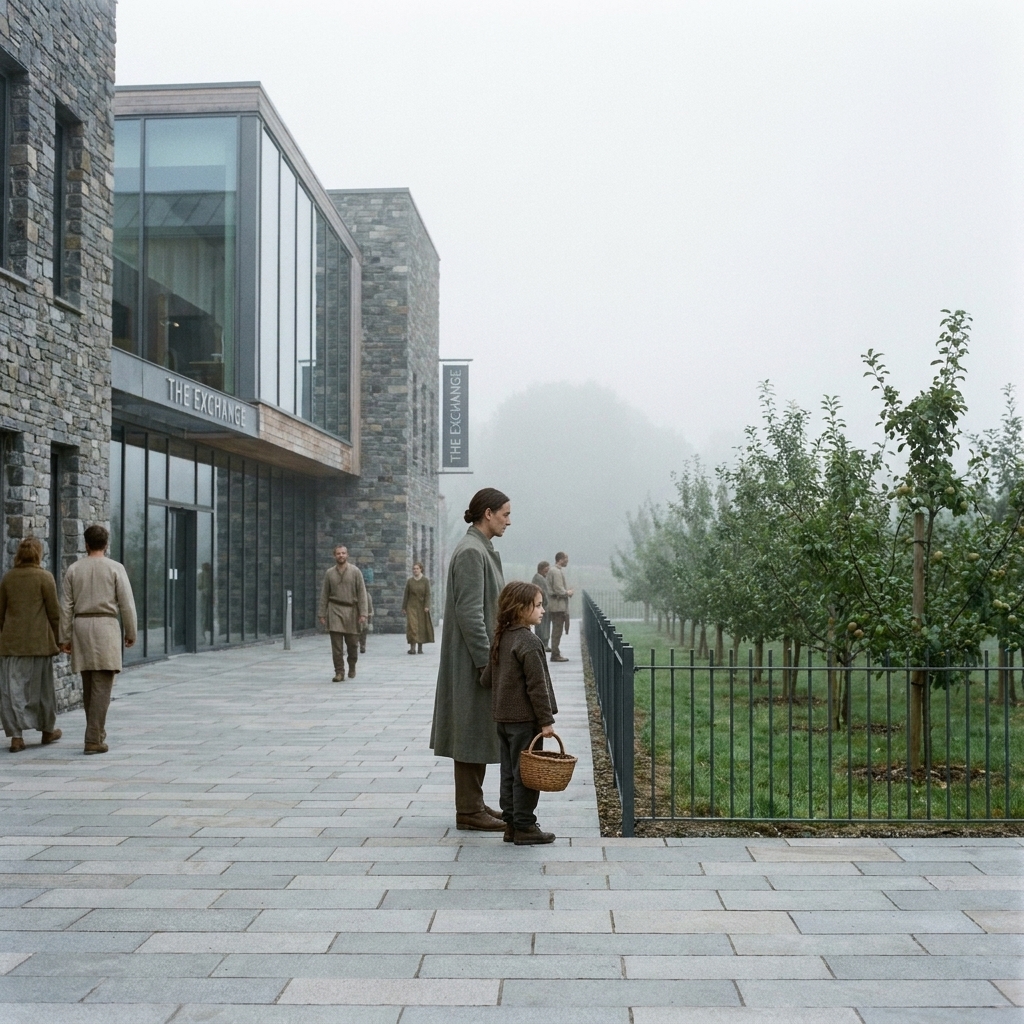
The Exchange and the Orchard
Letter 69 of the Book of Forgetting
At the town hall, the corridor smelled of floor oil and the particular dust that gathers in government corners. Nitzan Segal stood behind the Watch counter, her uniform collar turned up against the draft. She was a woman of about forty, lean, with a face that had forgotten how to soften, and she looked at me like I had asked for a confession.
"Nitzan, I'm asking as a measurer with a witness. Miriam is right here."
Miriam Segal stood at my shoulder, her basket over her arm, her face tight from the Exchange window.
"I can see she is, Fernando. You're not usually this formal."
"I want a direct answer. Does the Watch keep logs of guard positions or patrol routes at the east orchard camera posts?"
Nitzan glanced at Miriam, then back to me. "The Watch keeps network records, yes. But patrol routes?"
"Exactly. The routes. The timing. If so, where are those logs kept?"
"There aren't any. The guards move as they see fit. The posts are just… posts."
"Just posts? Then how did the guard find me the moment I stepped near the line?"
"Luck. Or he saw you from the road. The fog is just fog, Fernando, and the guards have eyes."
"I checked the poles. No wiring. No apertures. If there's no log, there's no record of who sent him."
"Which is exactly what I just told you. There is no log."
She turned back to her screen. The conversation was over. Miriam exhaled beside me, a short sharp breath.
"He's lying," she said, low. "Or he believes it. Either way, the posts saw me too."
We left the Watch office and walked the corridor to the Exchange. Uriel Gefen sat behind the counter, his ledger open. He was a man of about fifty, thick through the shoulders, with the calm of someone who has counted the same coins for twenty years. He looked up when we approached.
"Uriel, Oren said he'll vouch for collateral on my loan — what exactly will you accept, and can we settle this before Friday?"
"The Exchange's collateral rules are set by the Council; I can accept what you offer, but Oren's word helps and the final say rests with me."
"And if Oren vouches for something, does that shift your decision, or is the Council's rule absolute?"
"Oren's voucher carries weight, but I still weigh what you bring myself; the Council sets the terms but I have room to accept reasonable collateral."
Miriam's fingers tightened on her basket. "My map stock. It's not worth much to the Exchange. They want real property, not paper."
Uriel didn't look at the basket. "Bring what you have. Oren's word and your stock. I'll look at the numbers. But Friday is the deadline, Miriam. The Council doesn't move deadlines."
She nodded once, stiff. "I'll bring it this afternoon."
We left the Exchange. In the corridor, Dalia Shalev stood at the back table with the survey map unrolled, a coffee cooling beside her. Zipporah Gefen leaned over it, her waxed coat smelling of the mill and old oil. Zipporah was sixty if she was a day, retired from the mill, her hands still stained with grease at the knuckles.
"Dalia. I've got my sketch. You said meet at the paper?"
"Back table. Survey map's already unrolled. Coffee?"
"After. Let's look."
I stopped at the edge of the table. The map showed the quarry wall in fine lines, the six recorded blocks measured and numbered. Zipporah tapped a faint dashed line between block six and seven.
"Your hairline crack — you marked it between block six and seven on your count."
"That's where the survey shows a joint. Faint, but it's there. Dashed line."
"I didn't count it as a joint. My six blocks end before that line."
"Then your block six is longer than the survey draws. By about a handspan."
"My rangefinder gave the same total wall length. Just divided different."
"So the crack is real. The question is whether it splits a stone or marks a boundary."
"Survey calls it a boundary. Your seventh block sits on the other side."
Zipporah straightened, wiping her thumb across the map. "And the baby still says the fog doesn't measure the same twice."
Dalia's pen paused. "One thing at a time. You owe the Exchange this week."
"Going now. Then I'll come back with a tape and measure that seventh block myself."
"I'll be here. Bring the numbers. We'll write them down together."
Zipporah folded her sketch, tucked it into her coat. She passed me on her way out, her shoulder brushing mine. "The posts at the orchard, Fernando. You checked the bases?"
"Nothing. Wood and paint."
She nodded, already moving. "Then whatever sees you isn't on the post."
Dalia packed the map into its tube. Her recorder clicked off. "Three guards turned back at the fog line this morning. South, east, west. All the same words. Council prefers people at their work."
"Did you get names?"
"Uriel Segal, Eli Segal, Uzziah Kfir, Kenan Kfir, Nitzan Navon, Kinneret Sharon, Nathan Kedem. Seven. Not three."
She capped her pen. "Seven. Same script. That's not luck."
Outside, the fog held its line at the east road. The orchard camera posts stood in their row, wooden and silent. I walked the row again, my rangefinder in hand. No wiring. No junction boxes. No apertures. Just posts.
But the guard had found me. And the guard had found seven others. And the Watch kept no logs.
I stood at the last post, the one nearest the fog, and pointed my rangefinder at the white wall. The number held steady. Forty-two point three meters. Same as yesterday. Same as the day before.
The fog didn't move. The posts didn't move. The guards moved, and the Watch wrote nothing down.
I put the rangefinder away and walked back toward the plaza, the map tube heavy in Dalia's hand beside me, Miriam's basket clicking against her hip, the town going about its work as if the questions didn't exist.
Want the next letter when it is written?